
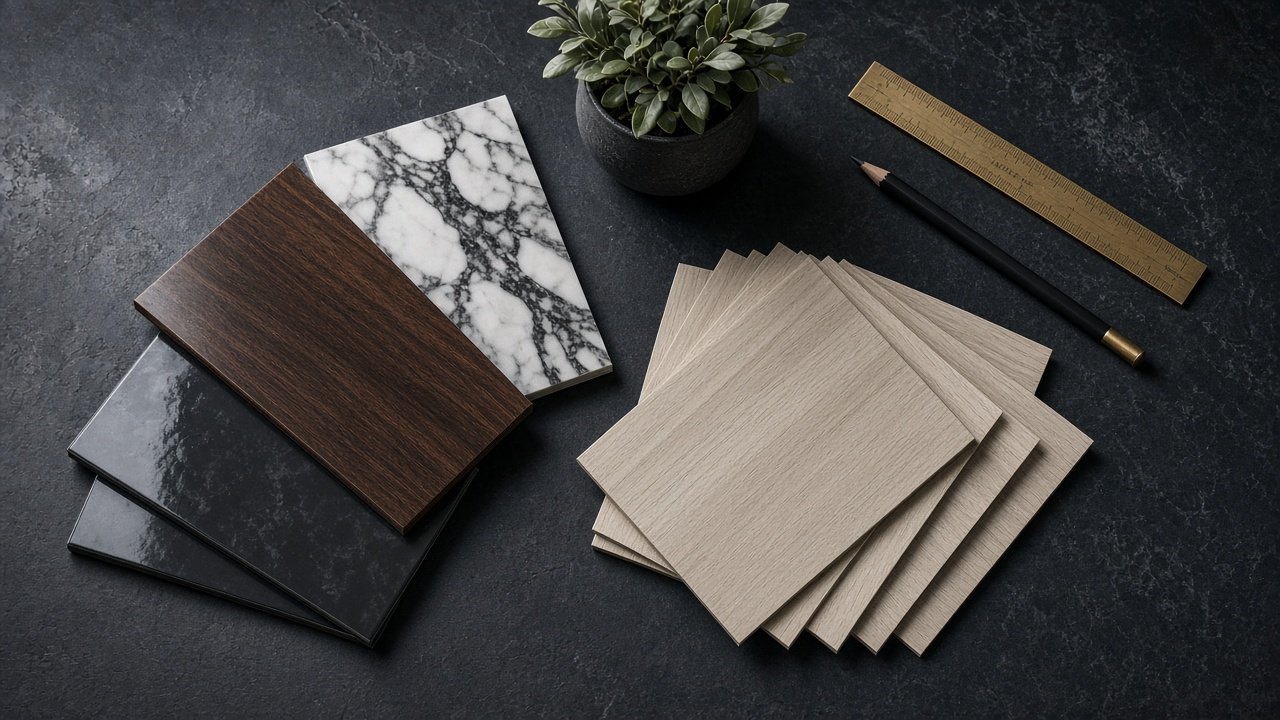
Almost every wardrobe, kitchen or office cabinet made in India uses two kinds of laminate: a decorative laminate on the surfaces people see and a liner laminate on the inside and back. For a dealer, knowing the difference between liner and decorative laminate helps you advise carpenters properly, quote jobs accurately and keep a sensible stock mix.
This guide compares the two side by side and shows how they work together in the same piece of furniture.
The short answer
- Decorative laminate is the "face" sheet. It's chosen for appearance, design and finish, and it goes on exposed surfaces such as shutters, table tops and wall panels.
- Liner laminate is the "inner" sheet. It's chosen for function and value, and it goes on cabinet interiors, shelves, drawers and the back face of panels.
Both are high-pressure laminates, made by pressing resin-impregnated papers under heat and pressure. The difference is mostly in purpose, design range, typical thickness and price position. For the basics of liners, read What is liner laminate and where is it used?
Liner vs decorative laminate: side-by-side comparison
| Factor | Liner laminate | Decorative laminate |
|---|---|---|
| Main purpose | Interiors, hidden faces, balancing the back of a panel | Visible exterior surfaces |
| Typical thickness | Usually thinner grades | Commonly 1mm in the Indian market; other grades available |
| Design range | Focused: light wood grains, walnut tones, plain neutrals | Wide: wood grains, solids, stone, fabric, abstract, metallic |
| Finishes | Mostly matte or lightly textured | Matte, suede, textured, high-gloss and more |
| Price position | Economical | Higher, varies by design and finish |
| Who chooses it | Usually the carpenter or contractor | Often the end customer, architect or interior designer |
| Typical buyer question | "Which shade matches and how many sheets?" | "Show me the catalogue." |
The exact thickness and specification depend on the manufacturer and range, so always check the product details before quoting.
How liner and decorative laminates work together
Take a typical bedroom wardrobe:
- Shutters, front face: a decorative laminate, for example a wood grain, a solid colour or a high-gloss finish.
- Shutters, inner face: a liner laminate, which balances the shutter and gives a clean finish when the door is open.
- Carcass interior (sides, shelves, back): a liner laminate in a shade that suits the face design.
- Exposed side panels: often a decorative laminate, because they're visible from the room.
Using decorative laminate everywhere would raise the job cost noticeably without adding much the customer will notice. Using only liner on the exposed faces saves money but usually disappoints the customer. Using both, each where it belongs, is what most carpenters do and what most customers expect.
Matching liner shades to decorative faces
A common question at the dealer counter is, "Which liner goes with this design?" A few practical rules help:
- Light wood-grain or white decorative faces usually pair well with light beech-tone or white liners.
- Dark wood-grain faces such as walnut or wenge often look better with a warmer walnut-tone liner, so the inside doesn't look too pale next to the shutters.
- Bold solids and high-gloss faces often pair well with a neutral liner, which lets the face colour stand out.
Bhavyam's shade codes include 7216 (Beech), 7211 (Golden Walnut), 7295, 7214, 7218 and 7244. Keep a physical shade card at your counter so carpenters can compare samples against the decorative design they've chosen. Confirm current shades on the catalogue page.
How dealers can plan stock for both
Every market is different, so there isn't one right ratio. Your stock mix should follow your own sales records. That said, these principles work for most dealers:
- Treat liners as a steady, repeat product. Liners are bought in volume for almost every job. Keep a reliable stock of your fastest-moving liner shades and grades so you never lose an order because you were out of stock.
- Keep decorative stock selective and catalogue-led. Decorative designs follow trends and customer taste. Stock the designs that move in your area and use catalogues for the rest. Our wood grain and solid ranges are a good starting point.
- Buy liners in consistent lots. Large jobs need many liner sheets of the same shade. Buying from consistent production lots reduces the risk of visible shade differences inside one wardrobe or kitchen.
- Match thickness grades. If you sell a decorative grade for shutters, stock a liner grade that carpenters can pair with it for balancing. Our liner thickness guide is coming soon.
Common mistakes to warn carpenters about
- No laminate on the back face. Pressing a decorative sheet on the front of a shutter with nothing on the back is a common cause of bowing.
- Badly mismatched face and back sheets. A very thin backer behind a thicker face sheet may not balance the panel well. Keep the pairing sensible.
- Using liner on exposed surfaces to cut cost. Liners aren't designed as feature surfaces. Customers often notice the difference on doors and visible sides.
- Mixing lots inside one job. Even small shade differences can show on adjacent shelves. Ask for the full quantity from one lot where possible.
Frequently Asked Questions
What is the difference between liner and decorative laminate?
Decorative laminate is designed for visible exterior surfaces and comes in a wide range of designs and finishes. Liner laminate is designed for interiors, hidden faces and balancing the back of panels, usually in thinner grades and a focused range of practical shades.
Can liner laminate be used on the outside of a wardrobe?
It can be pressed on, but it isn't designed as a feature surface and offers a limited design choice. For shutters and visible side panels, a decorative laminate is normally the better option.
Do I need liner laminate if I am using decorative laminate on the front?
Yes, in most cases. A laminate on the back face helps balance the panel and reduces the risk of warping. A liner is the usual, economical choice for this.
Which liner shade should I use with a dark decorative laminate?
A warmer wood-tone liner, such as a walnut shade, often suits dark decorative faces better than a very pale liner. Compare physical samples before deciding.
Does Bhavyam Laminates supply both liner and decorative laminates?
Yes. Bhavyam Laminates manufactures liner laminates along with decorative and high-gloss laminates, and supplies them in bulk to dealers and distributors.
सारांश (Hindi summary)
डेकोरेटिव लैमिनेट फ़र्नीचर के बाहरी, दिखने वाले हिस्सों के लिए होता है, और लाइनर लैमिनेट अंदरूनी हिस्सों और पैनल के पीछे बैलेंसिंग के लिए। सही जोड़ी से लागत भी ठीक रहती है और फ़र्नीचर टेढ़ा भी नहीं होता।
Stock liner and decorative laminates from Bhavyam
Bhavyam Laminates Pvt Ltd is a laminate manufacturer based in Jathlana, Yamuna Nagar, Haryana. We supply liner, decorative and high-gloss laminates in bulk to dealers and distributors across Haryana, Punjab, Uttar Pradesh, Delhi NCR, West Bengal and Jharkhand. We don't sell retail.
For shade cards, catalogues or a bulk quote, contact us:
- WhatsApp: +91 93552 25578
- WhatsApp: +91 98171 83438
- Website: www.bhavyamlaminates.com | Contact us