
If you sell plywood or laminates, liner laminate probably moves through your godown every week, even though it rarely gets the attention decorative sheets do. When a dealer understands what liner laminate is, it's easier to advise customers, stock the right range and avoid complaints about warped shutters or mismatched interiors.
This guide covers what liner laminate is, how it's made, where it's used and what to check when you buy it in bulk.
Liner laminate in simple terms
A liner laminate (also called an inner laminate or lining laminate) is a thin, high-pressure laminate made mainly for the inner and hidden surfaces of furniture. Decorative laminates are chosen for how they look on the outside of a wardrobe or kitchen. Liners are chosen for the inside of cabinets, drawers and shelves, and for the back face of a panel.
Liners usually come in plain colours, soft neutrals and light wood grains, typically with a matte or lightly textured surface. They're priced below most decorative sheets, which is one reason carpenters and contractors use them widely on surfaces that see less wear and attention.
How liner laminate is made
Liner laminates are made the same basic way as other high-pressure laminates (HPL):
- Kraft paper is impregnated with phenolic resin. These layers form the core of the sheet.
- A printed or plain decorative paper is impregnated with melamine resin. This becomes the visible surface.
- The layers are stacked and pressed under heat and high pressure. The resins cure (thermoset) and fuse into one rigid sheet.
- The sheets are trimmed and the back is sanded so the adhesive bonds well to plywood, MDF or particle board.
The total thickness depends largely on how many kraft layers go into the press. Liners are usually supplied in thinner grades than face laminates. Bhavyam Laminates manufactures in 0.62mm, 0.8mm and 1mm grades. For a full comparison, see our laminate thickness guide (coming soon on our blog).
Where liner laminate is used
Liner laminate is used wherever a surface needs to be sealed, cleanable and neat but doesn't need to be a design feature:
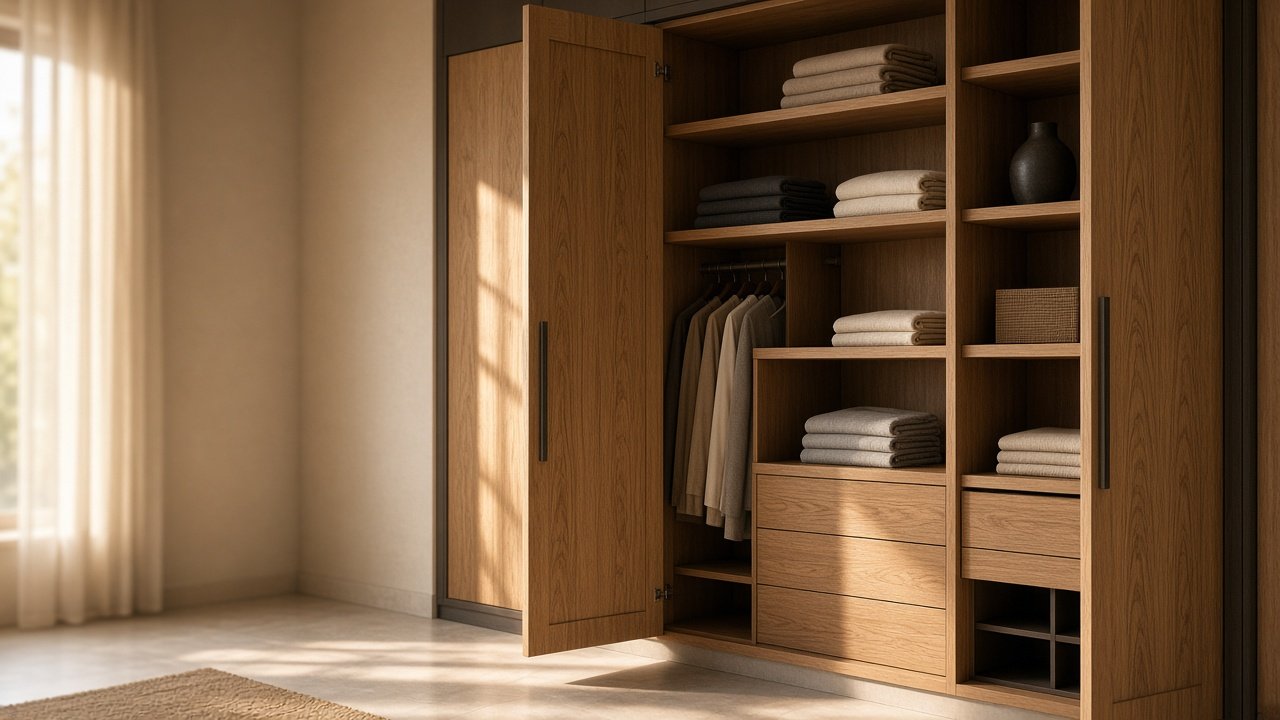
- Wardrobe interiors: inner side panels, shelves, the inside face of shutters and the back panel.
- Kitchen cabinet interiors: carcass sides, shelves and the inside of base and wall units.
- Drawers: drawer bottoms, sides and inner faces.
- Office and commercial storage: filing cabinets, pedestal units, lockers and storage racks.
- The reverse side of panels: as a balancing or backer sheet behind a decorative face laminate.
Why the balancing role matters
That last use is the one dealers most often need to explain. When a laminate is pressed onto only one side of a board, the two faces can react differently to changes in humidity and temperature. Over time, this imbalance can make the panel bow or cup. Shutters and long, unsupported panels are the most affected.
Pressing a laminate on the reverse face helps balance the panel and keep it flat. For that reason, a liner is commonly used on the back of shutters and panels that carry a decorative laminate on the front. Good practice is to use a backer that behaves similarly to the face sheet. In practice, that usually means pairing thicknesses sensibly and pressing both sides in the same way. The board quality, adhesive and pressing method also matter, so a liner alone can't guarantee a flat panel.
Common liner shades and finishes
Most liner ranges focus on a practical set of shades rather than a large design catalogue:
- Light wood grains such as beech tones, which suit most interiors and hide small marks.
- Warmer wood tones such as walnut shades, which pair well with darker decorative faces.
- Plain neutrals such as white, off-white and light greys, often used inside kitchens and offices.
Bhavyam's shade codes include 7216 (Beech), 7211 (Golden Walnut), 7295, 7214, 7218 and 7244. Shade ranges change from time to time, so always confirm current availability on the latest shade catalogue before you place an order.
What dealers should check when buying liner laminate in bulk
Liner laminate is a volume product, so small quality differences add up quickly across a large order. Before committing to a supplier, check:
- Thickness consistency. Measure several sheets at a few points each with a micrometer or vernier. Sheets sold as the same grade should be consistent.
- Shade consistency between batches. Carpenters often finish one job from two different lots. Ask how the manufacturer controls batch-to-batch shade variation.
- Surface quality. Look for dry spots, pits, scratches, resin patches or uneven texture under good light.
- Back sanding. The reverse side should be evenly sanded for a good glue bond.
- Flatness and edges. Sheets should lie reasonably flat, with clean, square edges and no cracks.
- Packaging. Good packing reduces breakage and edge damage in transit, especially on long routes such as Haryana to West Bengal or Jharkhand.
- Supply continuity. Choose a manufacturer that can supply the same shade codes repeatedly, so your regular customers aren't left waiting.
Our guide to liner vs decorative laminate (coming soon on our blog) explains how to position both products at your counter.
Where liner laminate is not the right choice
For exposed, high-wear or high-visibility surfaces such as wardrobe and kitchen shutters, table tops and counters, a decorative laminate in a suitable thickness is normally the better choice. Liners are also not the right product for curved or bent edges, which need a laminate specifically made for postforming, or for exterior use, which needs a product rated for outdoor exposure.
Frequently Asked Questions
What is liner laminate used for?
Liner laminate is used on the inner and hidden surfaces of furniture, such as the inside of wardrobes, kitchen cabinets and drawers, shelves and storage units. It is also pressed on the back face of panels as a balancing sheet to help keep them flat.
Is liner laminate the same as decorative laminate?
No. Both are high-pressure laminates, but decorative laminates are designed for visible exterior surfaces and come in a wide range of designs and finishes. Liner laminates are designed for interiors and back faces, usually in thinner grades and a smaller range of practical shades.
Why should liner laminate be used on the back of plywood?
If laminate is pressed on only one side of a board, the panel can become unbalanced and may bow or warp over time as humidity changes. A liner on the reverse face helps balance the panel and keep it flat.
Which thickness is common for liner laminate?
Liners are usually supplied in thinner grades than face laminates. Bhavyam Laminates manufactures 0.62mm, 0.8mm and 1mm grades. The right choice depends on the furniture and the face laminate being used on the other side.
Does Bhavyam Laminates sell liner laminate in retail quantities?
No. Bhavyam Laminates supplies in bulk to dealers, distributors and trade buyers only. Dealers can contact the team on WhatsApp for shade cards and bulk orders.
सारांश (Hindi summary)
लाइनर लैमिनेट एक पतला और किफ़ायती लैमिनेट है, जो अलमारी, किचन कैबिनेट और दराज़ों के अंदरूनी हिस्सों में और पैनल के पीछे बैलेंसिंग के लिए लगाया जाता है। डीलर और डिस्ट्रीब्यूटर थोक ऑर्डर और शेड कार्ड के लिए हमें व्हाट्सऐप करें।
Stock liner laminates from Bhavyam Laminates
Bhavyam Laminates Pvt Ltd manufactures liner laminates at Jathlana, Yamuna Nagar, Haryana, and supplies dealers and distributors in bulk across Haryana, Punjab, Uttar Pradesh, Delhi NCR, West Bengal and Jharkhand. We don't sell retail.
To get the current shade card, ask about thickness grades or plan a bulk order, contact our sales team:
- WhatsApp: +91 93552 25578
- WhatsApp: +91 98171 83438
- Website: www.bhavyamlaminates.com | Contact us